Sunday, March 16, 2025

The Day the World Stopped - Reflecting on Covid Teaching 5 Years Later - Part 1

The first time I heard the suggestion of closing school was from a senior in my video editing class.  It was mid-February.  "Miss Hawks, do you think they'll close schools because of this virus?"  My response was remarkably short sighted - "No, we don't close schools.  How would that even happen."  

A few days later, in a faculty meeting, my head of school said, "On Wednesday, we are going to have a 'just in case' meeting. We need to figure out what we will do in the event that we have to switch to remote learning for a few weeks. So come to this meeting with thoughts about what you would need to take home and what the kids would need to have at home."  Little did I know that the administration and the IT department had been talking about this for several days, deciding whether we would use Zoom or Google Meet and how to load everyone's class schedules in the calendar so all the student had to do was click on the link.  

Two and a half weeks after that "just in case" meeting, I was in a "this is happening soon, but we don't know how soon" meeting. It turned out soon was the following day.  Our very forward thinking administration filled with aggressive planners were shown to be wise indeed.  March 13, 2020 is the day the world stopped. It was the day we got the email that we would be going into a virtual learning environment immediately.  And, of course in the next few days, everything else started shutting down as well.

As massive life transitions go, I have to say this one went pretty smoothly - for us at GRACE.  Because they had been thinking about it already, the IT department started loading in class schedules immediately.  Teachers were allowed to come to the building for planning for two days and could do their virtual teaching from their classroom if they wished for the rest of that week.  I opted for this because I wanted to be near the IT department if I ran into any issues and wasn't sure if the wifi I had at home was robust enough.  After all, I hadn't chosen it with large amounts of streaming data in mind.  More importantly,  I knew it would be the last time I would see people for a month (it turned out to be much longer than that, but at the time, we had planned for a return after Easter break, four weeks later) because I live alone. I knew that was going to be hard for me, so I stayed at the school building for as long as they allowed.

So, we only lost two instructional days before teaching our first virtual classes on March 17, 2020.  As four weeks became six and six became the remainder of the semester, we checked in with each other every day to make sure things were going as well as they could, for emotional connection, and for prayer with each other.  Students were remarkably adaptable and helpful.  Parents sent me notes and emails of support (some even invited me to their homes for dinner because their child was worried about my being alone - which kind of misunderstood the point of what we were doing but was still very kind).

Being a single person who lives alone during this time was rough.  My parents came over once a week, which was likely a violation, but I would have been useless to everyone if I had lost my marbles from isolation.  We didn't touch each other at all. They just came over on Sundays and had lunch.  I had no physical touch from another human being for 10 weeks.  I don't know all the complexities of oxytocin, but I do know that having none of it did some screwy things to my brain that took a couple of years to recover from.  One evening, about 5 weeks in, I was watching TV and looked down at my hands to find that my right hand was patting my left hand.  I don't know how long it had been happening or if it was even the first time I had done that, but my body knew it needed something it wasn't getting.

Like all schools, we our administration had to plan for end-of-year activities, like giving kids things from their lockers, collecting textbooks and athletic uniforms, and handing out yearbooks.  Our graduation was perhaps the best in America.  I wrote about it here if you would like to read about it.

The summer was hardly one of rest, although as teachers, we got more rest than our poor administrators because they had to do all of the planning for the return.  We had multiple online meetings, not only about how to deal with spacing but also about racial reconciliation in the wake of George Floyd.  We made plans for how to teach in a way that would be equitable for those who would choose to stay home and those in front of us.  It was hard to know what the correct decisions were as there was no experience on which we could rely to show us the way.  My most common sentence as we returned was, "We're going to try this.  If it works, we'll keep doing it. If not, we'll try something else."

I can't write much about the hybrid year.  I'm still a little too overwhelmed by how hard it was to properly convey it.  It's kind of a "you had to be there to understand" situation.  We were working at 100% of our capacity every single day, and then there were days that required more, so we were living in an energy deficit.  I was so grateful to be back at school because I couldn't have handled any more alone time, but it was still exhausting to face spacing, cleaning, masks, temperature scanners, plexiglass, and uncertainty every single day in addition to the normal challenges of teaching middle and high school.  (I haven't even mentioned that we had a contentious election and an attack on the Capitol during this time.)  Thank God we had each other, supportive leadership, and cooperative kids and parents.  I can't imagine what people were going through in places that didn't have all of that.  One of the top five moments of my entire life was at the end of graduation that year when faculty and staff received a standing ovation from the parents of our kids as we walked into the aisle for the recessional. It took a moment to figure out what was happening, and then I felt all the feelings there are.  It was amazing.

When we took a photo together at the end of the year in our "We Did It" t-shirts, we knew it wasn't really over, but we were proud to have gotten through the most difficult year of our careers and had hope for the recovery.

I divide Covid into three parts - the virtual spring, the horrible hybrid, and the year that was supposed to be better (but wasn't).  When the hybrid year ended, most teachers and many students were vaccinated.  We spent the summer living footloose and fancy free.  Just as school was about to start back, the Delta wave hit, so we returned masked.  We had too; the numbers were just too high for anything else, and thanks to Omicron, we remained masked until Presidents' Day weekend.  We had some protocols around who could be virtual, so it wasn't as pervasive as the previous year, but there was still a lot of it.  We were in hybrid-lite, but the kids were done with it. They had been super cooperative with them the first year; I would see parents yelling on the news about masks and say, "This is an adult problem. The kids are fine with it."  That was true during the hybrid year, but if you made a word cloud of my 2021-2022 school year, the words, "Masks up" would have been the largest by a mile.  Things were supposed to be "back to normal," but unlike the beginning, there was no hard date on the end.  

Education has suffered in the world since the pandemic.  Attendance rates are at an all time low, not just in the United States, but worldwide.  Patience is low; demands are high. No one can agree on what to do about learning loss, or even if it exists.  And, since we never properly grieved (because part of the country, including its leader, doesn't want to admit this was real), we have not mentally and emotionally recovered from the chronic stress.

I'd like to reflect on the lesson we learned and what we can take with us, but this post has gotten very long.  So, let's call this summary part 1.  Next week, I'll try to bring it all together with some good lessons.


Sunday, March 9, 2025

Let Them Grow

“We want to be known but not to be memorized as though we cannot change.” 
- Beth Moore in All My Knotted Up Life: A Memoir

Once, I was making a seating chart for my physics class at the beginning of the year. One of our maintenance staff came in and saw what I was doing.  

  • "Oh, it's so awful you have Seth Morris (fictional name). He's the worst!" he said.  
  • I tried to ignore him, but he wasn't the kind of person who read social cues, so he kept talking, going on and on about this young man.  
  • "I like him a lot," I replied. "He's bouncy, and that takes some energy to manage, but I'll take that over kids who won't participate."  

It turned out that the one experience this man had with Seth was when he trashed a bathroom during an extracurricular event when he in the 7th grade.  This kid was in my physics class his junior year, which means it had been four years since the event that this man was still holding against him.  

I think about that conversation sometimes, wishing I had handled it differently.  

  • I wish I had said, "Yeah, he was a twerp in the 7th grade. We all were.  I'm glad no one holds my 7th grade twerp behavior against me now."  
  • I wish I had said, "This kid is just trying to grow the heck up, and it would help if you got out of his way."  
  • I wish I had confronted him in some way that might have prevented him from doing this in the future with other kids.  
  • Alas, I did not do any of those things. Hindsight is always sharper.

One of the best parts of teaching in the school I was in was that I got to watch kids change as they grew. Because of my role as yearbook advisor, I often got to see kids from kindergarten through graduation.  I taught all 8th graders for 21 years.  For 11 years, I got them all again in 10th grade chemistry.  I often had 20-40 of them again in physics during their junior or senior years.  Let me tell you, the kid you know as an 8th grader is not the same young adult who graduates five years later.  Sometimes, they aren't the same at the end of the year as they were at the beginning.  Sometimes, I got the amazing experience of wondering how a kid was so different this week than he was last week.  Growth is not linear, so there are spurts and plateaus, and occasional regressions, followed by more spurts. 


In one of my favorite works by C.S. Lewis, Perelandra, the character known as The Green Lady describes learning in terms of agin. Every time Ransom explains something to her from Earth culture, she thanks him for making her older than she was before. We presume as people get older, they have experiences that teach them new things; her description was simply an alteration of that idea.  Seth, from my earlier story, had grown a lot between his 7th grade year and his junior year, and he was no longer a bathroom trasher.  In fact, he was likely the one who would have helped you clean up after an event.  

The reason this is on my mind today is that I had an interaction earlier this week.  There is a young man who comes into the Y every day.  I'll call him Kadeen. He's a handful, and he certainly hasn't been taught respectful interactions with adults, but I have seen him exhibit moments of kindness (like giving someone an extra bag of chips that came out of the vending machine).  I was mentioning something about finding an item for him in lost and found the day before, and one of the women I work with starting talking about what a horrible kid he was and how he would likely end up behind bars someday.  "I know I shouldn't think this way, but I do," she said.  I said, "I've seen him have some sweet moments, so there's some good in there somewhere.  We'll see what happens as he gets older"  She wasn't having it. Setting aside how annoying I find it when people can't agree that I have seen something if they weren't around to see it, I said, "I've known a lot of kids who seemed that way when they were young but changed a lot as they aged."  Long after we had ended this conversation, she brought it back up, saying he was one of those people who would have to hit rock bottom before anything changed.  This kid is 13 years old! Are we really writing his future off already?

If you know me, you know I am not saying some such nonsense as "There are no bad kids, only bad circumstances."  We are all sinners in need of grace and mercy.  (Even if you aren't a person of religious faith, you know that we are all more likely to do the wrong thing than the right thing if it serves us better.)  What I am saying is that people change, and kids are not yet who they will one day become.  I had a shorthand with the teacher next door to me. We used to look at each other and say, "Half baked."  It was our reminder that the kids weren't done yet. They wouldn't even be done when they graduated.  Just like no one would take a cake out of the oven half way through the baking process and toss it out because it was a mess.  Of course it's a mess; it isn't finished yet.  Of course your students are a mess; they aren't finished yet.  (Oh, man I just had the weirdest memory of a song from 80s kids' church - "Kids Under Construction")

There's a sentence that frequently pops up on social media - "When someone shows you who they are, believe them."  And I don't disagree with that statement if we are talking about an adult who has exhibited a pattern and shows no signs of remorse.  It is likely that person is acting out of his well-established character, and this is unlikely to change without a fairly large intervention involving repentance.  But when people show genuine signs of change, we should allow that, even if we are cautious in doing so.  

And when we are talking about kids, it's important to recognize that they are not just small adults; their character is being molded by every experience they have. We should be honored and humbled that we are part of that; it's an awesome responsibility.  While we hold kids accountable for their actions through discipline, we recognize that those very actions might help them to change (the root of discipline is disciple, so it should be teaching them something).  If we see a change in pattern, celebrate that as a success. Don't hold the action they've already been disciplined for against them months and years.  

One of the things I will miss this year about being in the classroom is that I won't have the opportunity to write college recommendation letters.  Writing those for kids I had known since middle school (and sometimes seen since elementary school) was an annual reminder of how God uses the process of maturing, learning, discipline, and experience to make us older, not only in the chronological sense but in the Green Lady sense.  

May we all be older at the end of the day than we were at the beginning.  

And recognizing that in ourselves, let us allow it in others too.

Sunday, March 2, 2025

Stress - Don't Avoid It (Teach Students to Embrace It)

This time of year is often one of the most stressful in schools.  

It's usually a time with projects because you have learned enough to do something with your knowledge and far enough from the end of the school year to have time to grade them.  It's a time with yearbook deadlines, tech weeks, post-season games, and college acceptance/rejection letters.  For some reason, there is a week during this time of year when it seems kids are having a test in every one of their classes.  

Our impulse as adults is to alleviate all this stress in the name of mental health, but I would suggest instead that it is a time to teach coping mechanisms.  Removing stress may seems like it is good for them, but removing stress does not build strength. Coping with stress does.  It's focused on their future mental health.

In biology, we have learned that organism that don't experience stress die. Appropriate amounts of stress stimulate growth.  

Consider weight training.  You intentionally subject your muscles to a higher than normal load. The muscle fibers break down. But that causes them to rebuild with more dense connections. That increase in muscle density makes it less stressful the next time it experiences the same load, reducing future stress through response to current stress.  

Temporary life stress also causes us to respond. We develop coping mechanisms that we can employ in the future. We gain strength, knowledge, and skills that keep the same load in the future from being quite as stressful.

It's important to recognize the difference between stress and trauma.  Stress is an increase in load over your normal state.  Trauma is a load increase that is either high enough or comes on fast enough to break the dams of your coping mechanisms. 

Returning to the weight training metaphor - If you are at point where you normally bench press 50 pounds, and you put 60 pounds on the bar, you will likely struggle a bit, lift it with poor form for a while, and be rather sore at the end of your session. That's a stress that leads to growth and may eventually lead to ability to lift 100 pounds if you add to it incrementally as you adapt over time.  If, however, you put 100 pounds on your bar today, you will likely drop the bar on your chest and break your sternum or crush your lungs.  That's trauma - It's not possible for you to handle it with normal responses.

I'm not suggesting we subject kids to chronic stress all year in order to build strength. I'm suggesting that a week here and there of higher than normal stress need not be avoided.  They may look back at the end of it and recognize they are stronger than they thought.  They'll definitely learn to deal with future stress better.


Sunday, February 23, 2025

The Antidote for February Fever - Remember Your Impact

Teachers, I have good news for you.  February is almost over!  February Fever used to get to me every year.  It's been a while since Christmas, and spring break is a way off.  There are unexpected interruptions to your routine.  You may have a little Seasonal Affective Disorder, and so do the kids.  

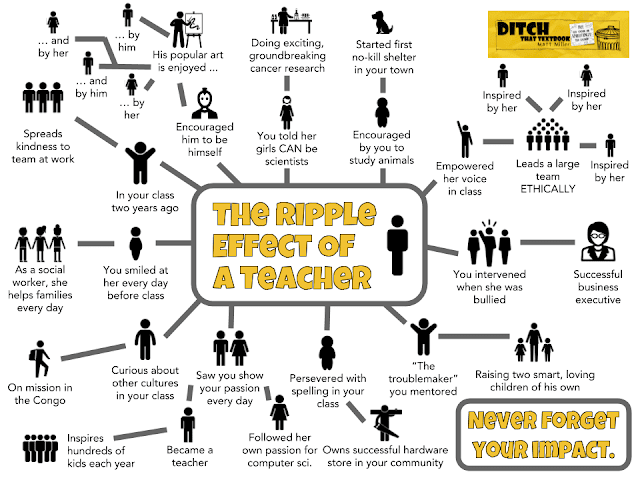
What I always found helpful during these doldrums of the year was to remember my purpose and my impact.  Rather than focus on the day to day grind in front of you, remember the long term. You walk into a classroom every day, expected to equip, challenge, and inspire every student. There are kids who will be able to read because of your work.  There are people who will go into medicine because of your inspiration. You have students who will carry a love of art, theater, or literature because of you.  If are being discussed at dinner tables, and you may continue to be discussed years from now when your students tell their own children about you.  You build up students into people with a broader view of the world than they would have if you hadn’t been their teacher.  It’s an awesome thing to consider.

One of the reasons I know this is true is the memory of my own teachers. You'll find stories of them in this blog because I write Thanksgiving posts about them. I was a nerd who loved school. I never viewed it as utilitarian, a way to get into college, or job training. I did, of course, love some subjects more than others. History was my least favorite.  Yet, I had a middle school history teacher named Mr. Watkins whose passion for the story of Czar Nicholas and Alexandra of Russia was so strong that I couldn't help but be drawn into it.  A decade later, I found myself in a Tulsa art museum with tears streaming down my face as I stood in front of Alexandra’s crown and a desk used by Nicholas.  I don’t normally have emotional responses to furniture and jewelry, but a teacher inspired me in a way that made me care (and had nothing to do with getting a job).


Students don't always tell you the impact you are making, so when they do, hang onto it.  If you get a nice email from a student or parent, keep it in an encouragement folder so you can revisit it when you need to.  Keep a box or drawer for the random little tokens of affection you get (random drawings, silly inside jokes, end of the year notes, etc.).  When someone does tell you how you affected them, hold onto it, and remember that there are likely more of those stories you don't know.

I occasionally run into former students of mine in public.  I have run into them at movie theaters, grocery stores, and even airports.  There is nothing quite like the feeling of hearing "Miss Hawks?!?" from across a room.  Since I began working at the YMCA, there have been a surprising number of encounters with those I once taught. Some are there to get their lifeguard certifications. Others are there to work out in the gym or play basketball.  Some come in to bring their kids to swim lessons. Whether I had them last year or two decades ago, they stop by the desk and remind me that there is impact beyond the year I taught them.

Quite some time ago, I was in a restaurant.  A young man excitedly said my name.  It was a young hot head a taught in a school where I only stayed for one year (a year I often gloss over when thinking about my career). He turned to his friend and said, "This is the teacher who put up with all my crap."  Yep, that's exactly what I was.  I don't know what impact that had on the man he is today, but I hope it had some.

The only reason I had an influence on any student is because my teachers influenced me.  It's a chain reaction, and you are part of that chain.  

Sunday, February 16, 2025

Formative Assessment - Part 3 - Secondary Effects

All educational practices, both effective ones and ineffective, have side effects.  

Some side effects are undesirable: 
  • lost instructional time from over-adherence to inquiry
  • lack of development of organizational skills because Google Drive is searchable and doesn't require organization
  • lost focus from attempted "multi-tasking"
  • anxiety from large amounts of high-stakes testing
Some side effects (even from the same practice) are great:
  • increased relationship development during an inquiry experience
  • students with ADHD not losing all of their work because Google Drive is searchable and doesn't require organization
  • recognition of how important focus is after an attempt at "multi-tasking"
  • recognition that you are stronger than you think you are when you persevere through a time of high-stakes testing.
I have noticed some side effects of implementing intentional formative assessment in my classroom.  I have yet to find an undesirable effect, but there are three strong upsides that I have particularly noticed.

1.  Keeping them on their toes
It is possible for apathetic students to go entire days without paying attention to the teacher.  If teachers are merely calling on those with their hands up, the uninterested student can simply not raise his hand. If she knows she has tutoring later, the uninterested student might check out and do some online shopping, knowing she can learn it later. 

Without checking for understanding, a student can get all the way to test day without a teacher ever knowing he is lost. 

I like it when educational principles show up in my life outside of school, and this is one of those times.  I mentioned a few weeks ago on this blog that I have been attending a liturgical church for about a year.  Liturgy often involves a fair amount of call-and-response style participation from the congregation.  A couple of weeks into my attendance at this church, I said to a friend, "There is no way to let your mind wander there." She asked what I meant, and I showed her the bulletin.  "Everything in bold print is something I'm supposed to say.  So, I can't let my mind wander because I've got a line coming soon."


Ongoing formative assessment that requires participation from all students is just like that.  They have a line coming soon.  It keeps them engaged because they know they will be asked a question about what they are doing now about three minutes from now. No one wants to hold up their mini-whiteboard to show a ridiculous answer, so after a few questions, when they realize you really are going to keep doing this, they usually pay better attention.

2. It is motivating to know what your progress is
Have you ever suffered from the illusion of competence?  You know what I mean, you studied for a test, and you were sure you were going to ace it until you actually had the test in front of you and realized you didn't know much.  

Students who are engaged in regular formative assessment have much less of that experience.  Not only do you have frequent check-ins with their understanding, so do they.  Is it a bummer to get a question wrong? Yes.  But that is not a reason to abandon a good practice.  When they get it right the next time, call out how far they have come. "Remember when y'all couldn't do that?  Look at you now, doing it well. Thanks for putting in the work." 

There is not much that encourages people to grow like actually seeing their growth. It's why people in weight loss programs weigh themselves. It's why coaches show their teams game footage.  I'll give you another example from my outside-of-school life.  A few months after I started taking cycle classes at the Y, I began setting goals about distance, tension level, and power on the bike.  At first, I only knew how to check these statistics at the end of a class. I was often surprised to get to the end of a workout and find that I hadn’t achieved as much distance as I had thought.  Because I wasn’t tracking that information at all during the class, I didn’t have the ability to make adjustments that would help me reach my goals.  I could do better on a different day, but I didn’t know how to do better at the moment.  Then, an instructor showed me how to use the bike’s computer to see real time information during class by changing the display screen.


Checking the number on that screen was motivating because I knew if I needed to speed up or turn up the tension. I could adjust my course of action based on what I was seeing.

But be careful, you can have too much of a good thing. I found it was tempting to stay on that screen.  After all, feedback is good, right?  We like having constant access to information, but I quickly learned that was unwise.  It made me so focused on the number that I couldn’t pay attention to instructions.  Worse, I was so focused on the number that I couldn’t enjoy doing the things that would improve the number, and I was in a state of panic if the average didn’t move as quickly as I thought it should.  Worst of all, I wasn’t building any internal sense of how to improve because I was relying too much on the bike itself rather than how my legs felt or my perceived level of exertion.  Eventually, I disciplined myself to only visit that screen once every four minutes.  That gave me enough information to figure out what I need to do to make progress for the next four minute check, but it didn’t do my thinking for me.

The same is true in formative assessment. Stop and check at the crucial moments and the hinge information, but don't make them sick of hearing "Take out you whiteboard."

3. The joy of more classroom interaction
I mentioned earlier that it is possible for a student to go through a day without paying attention. It is also possible a for an introverted student to go through a day without having anyone interact with them. One of the best ways to do formative assessment is to require everyone to give an answer. My favorite way of doing this in the past few years was to have each student answer questions on mini-whiteboards. In a quick glance, I can see 24 answers and know if there are several of them with the same misconception. I can see who is taking longer to write their answer and who is copying off of their neighbor. It's great. What I didn't expect was to get so much joy out of their idiosyncrasies.

My favorite example of this was a boy named Jonah. He put on a front of being a cynic and too cool for school. Yet, he was a gifted mathematician and wrote excellent explanations of complex topics. He also had a wry sense of humor, but he never wanted to appear engaged in class, so he didn't use it there. However, he was required to write answers on his whiteboard, leading to some fun moments.

I don't know if this story is going to translate into writing, but I want to give it a shot. One of the things I do early in the year with 8th graders is teach them the names and functions of lab equipment. I explain that on tv, every piece of glassware is called a beaker, but in actual labs, it is important to be precise with your language so you get what you need for the purpose. We then play a game I call, "Beaker - Not a Beaker." The kids spend the rest of the year giving me a hard time by calling beakers flasks and vice versa. So, the first time we used whiteboards for retrieval, Jonah wrote "Beaker" as his answer a couple of times. I finally said, "That's great. You can do that, but you also have to write a real answer." For the rest of the year, he wrote two answers for every question, Beaker and whatever the real answer was. Then, during an exam review, there came a magical moment. I asked a question where the answer actually was "Beaker." He held up his board with, you guessed it, two answers: Beaker and Beaker. I laughed, and he responded with the slightest of smiles. It was a sweet and joyful interaction that I couldn't have planned and that wouldn't have happened if I wasn't regularly engaging in formative assessment with all students.

I hope in these three posts that I have convinced you that there is value in implementing a structured program of formative assessment and given you some practical ways of doing it. If you have a favorite tool for formative assessment, please post them in the comments so everyone can add to their toolbox.

Sunday, February 9, 2025

Formative Assessment - Part 2 - How to Know and What to Do When You Know

"How will I know?  Don't trust your feelings.  

How will I know?  They can be deceiving." - Whitney Houston

Two weeks ago, I told you the story of why we need formative assessment, but if I had included what it is and how to implement it, the post would have been far too long.  So, I made you wait a while for the practical part.

Let's start by defining formative assessment.  If you look online, you will only find about 48 definitions, and if you Google it, you will get a different answer from the Google AI every time (I've gotten six so far). So, let's look to some credible sources.  Kevin Washburn calls formative assessment “a teacher’s assessment activities while a student is learning.”  Dylan William describes it as “any activity that provides information about student learning and enables teachers to adapt teaching to meet student needs.” If you put these together, you have a pretty good definition, focused on timing and purpose.

There are many ways to collect data in the classroom, both informally and formally. 

Informal: 

I'll discuss the informal first as it what you will do with most of your day.  I mentioned last week that there are pitfalls to trusting the vibe in the room, but what I really mean is don't trust it alone.  While you need objective data to confirm or contradict it, the vibe is still valuable. As Douglas Fisher and Nacy Frey say In their book Checking for Understanding, “Talented educators know that the opportunities for fine-grained analysis of student learning are all around us.  Each time we host a discussion with students, examine a child’s writing, or listen closely to a question, there’s a chance to assess formatively.”And the more experience you have, the more accurate you will be at interpreting those hundreds of pieces of data.

So what are you looking for?

  • Changes in Body Language - If the kid that is usually leaning in is suddenly fidgety, leaning back, or puts his head on the desk, chances are you've lost him.
  • Changes in Facial Expression - The girl who is usually sparkling with interest goes a little glassy eyed or stares into the middle distance?  She's likely confused.
  • Aimless Searching - If you ask a question and the student flips through his book or notes with no evident destination, it is likely because he doesn't know what he's looking for.
  • Disconnected Answers - When you ask a question like, "What number would I change to balance this equation?" and the student answers with the name of an element. Or you ask, "Which character in the novel exhibits hubris?" and the student answers "Motif." These students are lost.
  • Explicitly Telling You They Are Lost - Students DO NOT like to admit they are lost, and much of the time, they don't know they are.  If you have a student actually say it out loud, you have found golden treasure, my friend. Do not make the mistake of brushing it aside.  Take the time to figure out where they went wrong.
  • Nodding: God bless the nodders and those that make sounds of recognition.  I had one that kept me going through the hybrid year of the pandemic. He may never know how crucial it was
Formal:

Most of your formative assessment should be planned, involve the entire class (or you will only hear from those who are confident), and you should have some idea of what their wrong answers could be, what misconception they reflect, and how you will respond.  This is what Dylan William calls "Working Plan B into Plan A."  

I know, it's a lot.  That's why you want to think it through while lesson planning rather than on the fly.
  • Identify your crucial content - While all your content is gold, you know there are some points on which future understanding depends.  Ask yourself what the points are in your lesson that students MUST get before you move on? Plan some high quality questions about those.
  • Ask questions in such a way that they can't get them right by accident. - The point of this is to reveal their thinking and identify their misconceptions, so if your question is vague, there is no point in doing it.
  • Plan and communicate your means of participation - Do you want to use multiple choice questions and socrative (or Kahoot or clickers or the many other methods of answering multiple choice questions)?  Do you want free responses on mini-whiteboards? Do you want open ended written responses in GoFormative? Do you want students to answer out loud in unison? Do you want to cold call?  The answer to any of these questions can be yes or no, but you want to decide ahead of time and communicate it to the students. Otherwise, you will revert back to the easiest but least informative method - calling on a kid with his hand up.
  • Think about likely wrong answers. - If you have been teaching for longer than one year, the chances are high that you have gotten the same wrong answers multiple times.  If you teaching middle and high school, you may have gotten the same wrong answers multiple times in the same day. Start anticipating those while planning. Why might a student answer that way? Is there a misconception they are likely expressing through that answer?
  • Plan how to address those misconceptions - Is this a minor thing that can be quickly addressed by saying, "I can see why you might think that, but . . ." Or will it require some time to reteach and practice? If there is a likely misconception that will take time to deal with, make sure you have enough room in your plan to do that.
Teaching is exhausting, y'all.  And it is so easy to fall into the trap of saying, "Does everyone understand?" and moving on if no one says no.  And, unless you have me in your class, it is highly unlikely anyone is going to say no.  The same goes for "Any questions?" and my go easy go to "Does that make sense?"  Students don't know what they don't know, so we have to draw it out of them by asking them to summarize or explain their understanding.

I've found a few other delightful secondary effects of using formative assessment, so I'll talk about those next week.  

For now, go find out what your students know.  You might be surprised.

Sunday, February 2, 2025

We Interrupt This Program - Teachers Protect ALL Kids

I intended to continue the series on Formative Assessment this week.  I really don't like when I have to turn my education blog into political meddling.  But every once in a while, there is a story where the two worlds overlap, and feel compelled to weigh in.  That has happened this week.

I am, of course, talking about the new presidential administration's change in orders about ICE agents going into places that had traditionally been considered off limits, namely hospitals, churches, and schools.  While that was not codified until 2011, it had been traditional practice for much longer as these places are widely recognized as places that should be welcoming, safe, and open to all.

The new regime doesn't often recognize what is codified, and they care even less about tradition.  So, we now have armed ICE agents with full authority to enter a school and demand that an undocumented 9 year old be handed over in the name of national security. There is also a strange proposal to turn IRS employees into ICE agents as though all government employees are equally qualified to serve in multiple roles. (Actually I don't know if that is true.  It's just something I read on Twitter.  It's hard to know right now because reality is more bizarre than fiction.)

I want to start with the fact that I believe in the rule of law.  Like a lot.  I don't even speed.  I believe in doing things the right way.  Once, in high school, I accidentally saw an answer to a test in my peripheral vision and intentionally put the wrong answer on my test so I would know for certain I wasn't cheating.  I'm saying all of that so you know that I am not a person with a sense of relative morality.

But I also know we are talking about something more complicated than a speeding ticket.  We are talking about families who have made the difficult decision to leave their homes to come to America seeking a better life.  Some of them attempt to enter legally, through claims of asylum, only to have the chief executive of the US mock them and call them liars in his speeches.  They are told to use an app that is difficult to access and to remain in poorly maintained camps in Mexico.  So, some of them do cross illegally because the cost of trying to do it the right way is just too steep.  If you expect people to follow the rules, you can't make them nearly impossible to follow.  But . . .

Rather than address the problem by making legal immigration easier, this administration has chosen to address the issue down river.  They eliminated the app that, while poor, did at least provide some with the right way to do things.  One of Trump's first executive orders was to end birthright citizenship.  While that one will likely be struck down by the courts because he can't change the 14th amendment with an EO, it is causing confusion and damage in the meantime.  And, on day 2 of his administration, the promised "mass deportations" started.  ICE agents are going into communities with a high latino population and rounding people up.  They are being treated inhumanely - it's one thing to put them on a plane to send them back; it's another to put them in chains while doing so - and the border czar brazenly says that all undocumented people should be frightened and just go ahead deport themselves if they want to avoid being treated this way.  

Thanks pro-life party.  Apparently, the sanctity of human life only exists until you are born.

I know I haven't gotten to the school part of this yet, but there is so much involved with this rapid change that it is all muddled up in my brain and needs to be worked out a little.

Okay, for the school part.  When I taught in public school, we did not know the immigration status of any student.  It wasn't our job to know.  The only thing required by a school for enrollment was proof of address, which most people presented using a water bill or something similar.  After that, it was the job of the school to provide the best education we could for every child sitting in front of us.  I had children of every color, race, and creed.  I had refugee sisters from Zaire who spoke little English (and we later learned one of them was deaf because of the bombs that exploded near their home).  I had kids who had spent the weekend in jail for theft sitting in my class on Monday morning.

At no point did any of us say, "We can't teach him because he's a criminal." or "We can't teach her because her English skills are nonexistent." or even "I can't teach the redneck in my class because he's a bigot."  We taught the kids in front of us to the best of our ability.  That was our job.  

Teachers help kids with everything from the heartache of a breakup or divorce of their parents to treatment of injury and cleanup up vomit to the de-escalation of a conflict between two kids competing for alpha status. We kept them as safe as we could during Covid and have dealt with their high levels of anxiety.  Any teacher that has been in the business for more than a couple of years has probably had to prepare themselves with a threat of violence at some level.  We are trained in lockdown procedures and what to do if a gunman enters our classroom.  During my 2nd year, a threat letter was found at my school, and I told every one of my classes, "No one is getting to you without going through me first." 

Do you know how many hours of class time are taken each year to do fire drills, tornado, drills, and lockdown drills. We do this in spite of the fact that school fires are rare and few tornados take place in the middle of the day because we are told that our primary job, even before educating them, is keeping them safe from harm.

Now, teachers are being asked to stand aside while armed ICE agents come in and take away undocumented kids.  Kids don't make the choice to illegally cross a border, but they are being taken from schools without due process.  And, it doesn't just affect them.  The rest of the class has to sit there and watch as armed men take one of their friends away. (Republican lawmakers, here's a note for you.  You're going to need to allocate some more money for mental health services for this generation of kids because you are going to cause large scale PTSD in a number of communities.) 

Even though they turned out to be incorrect, I was proud of the school in Chicago who turned away men they believed to be ICE agents.  (It turned out to be secret service people investigating a threat on a politician, but I'm going to say that, in the current climate, it's on them for not calling the 90% Latino school to explain who they were before they showed up.). They followed their training, later issuing this statement in their correction to the original story.

"Our security and clerk team followed the protocols that we've been trained and practiced and have discussed, and due to that we were able to ensure the safety of our school and all of our students," Ortega said. "We will not open our doors for ICE, and we are here to protect our children and make sure they have access to an excellent education."

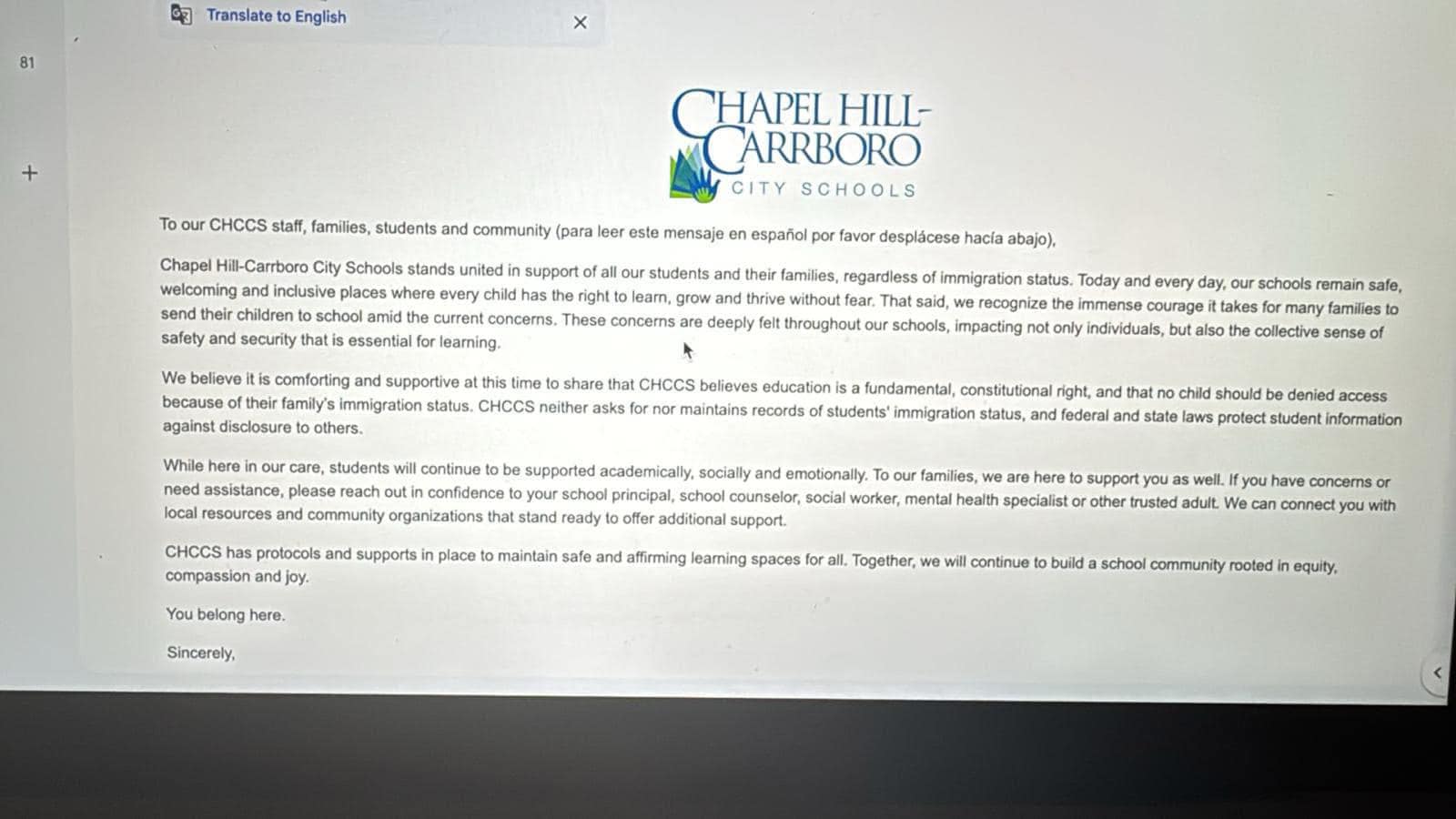
Schools everywhere are having to send out communications like the one below, posted by my friend who is a school social worker.  

To those who have been screaming for the last decade that schools should stop trying to "indoctrinate kids" and just teach them reading and math, please know that you are making it harder to do that.  Teachers now have to focus even more of their mental resources on student anxiety, standing up to bullies of all types, and think through what it will take to keep them safe from a new threat.  

If you want teachers to be able to teach, stay out of their classrooms.

I'll get back to the education part of this blog next week.

Design Communicates Philosophy

I promise this post is about education. It just takes me a minute to get to it. Hang in there. ------------------------------- If I ever get...